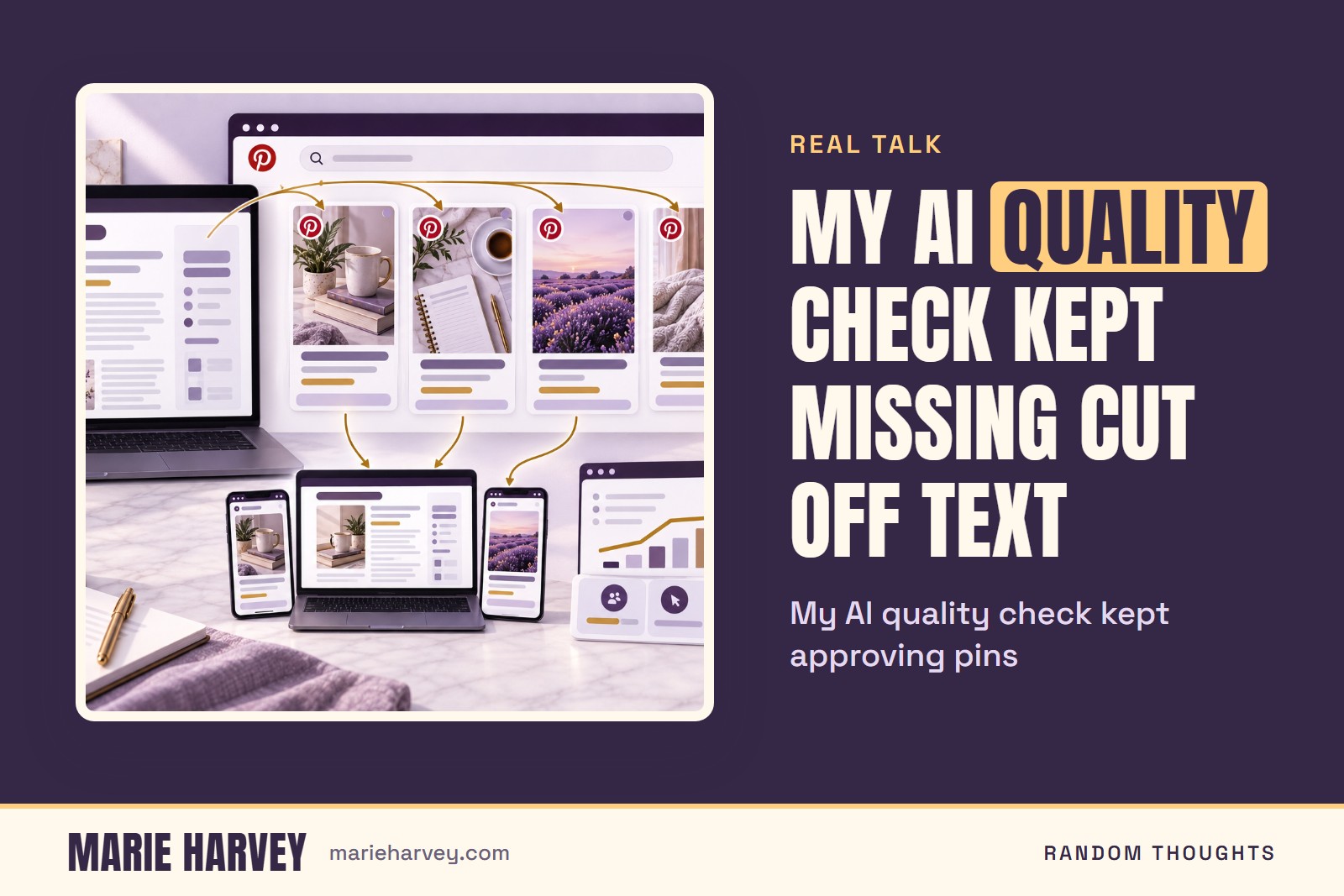
My AI quality check for Pinterest pins kept approving pins with cut-off text, so on September 15, 2026 I replaced a visual check with a measurement. Every pin's text now gets measured after it renders, and any pin with clipped or covered text fails automatically. Here is how the old check missed the problem, what the new one does, and what happened to pins from earlier batches.
What was wrong with the text on my pins?
Headlines and descriptions on the Marie Gems Pinterest pins kept ending mid-phrase with an ellipsis. It showed up in one batch, then three pins had to be dropped from a later batch, then five more from the batch after that. The pin generator was sizing text by character count, which is a guess about how much room words will take, and the guess kept coming out wrong.
Why did my AI quality check approve cut-off text?
Because it looked at the pins and called the ellipsis intentional. In my setup, one agent designs a batch and a separate agent checks it, and both of them waved the truncation through as intentional. That is the uncomfortable part of this story: the checking step existed, it ran, and it still said the batch was fine. A visual spot-check was not a reliable judge for this kind of defect, and a measurement is.
Why can a character count not tell you whether text fits?
Letters are not all the same width, and the real width depends on the font once it loads in the browser. A character count is decided before any of that happens, so it cannot know whether a headline will run past the end of its line. The only way to know is to render the pin and measure the text that actually landed on the page.
How does the fit script work now?
Every pin now carries a small script that fixes the text after the fonts load. It shrinks a headline or description one pixel at a time until the full text fits its allowed lines, and it will not go below a floor of 32 pixels for a headline or 20 pixels for a description. It also hides any decorative ornament that lands on top of text. The renderer waits for that script to finish before it takes the screenshot, so what gets saved is what got fitted.
How does the measured check work?
A separate checker script measures every pin, not a sample, and fails any pin where text is clipped or covered. It is mandatory in the instructions for both the design agent and the checking agent, so neither one can decide to skip it on a busy day. That matches something I wrote about earlier in the difference between using AI and building an AI workflow: a gate that can talk itself into skipping the check is not really a gate.
What happened to the pins from earlier batches?
The run that found this stopped at a built-in safety limit, and I approved the fix the same day. The designs stayed the same, and only the five truncated headlines got smaller, by 2 to 5 pixels. That batch was re-rendered and shipped 20 of 20.
The new checker also flagged five pins from two earlier batches. Three were already live from one batch: two with an ornament sitting on the description and one with a clipped description. Two more, from the batch before it, had an ornament overlap. I swapped all five. Each was re-rendered with the fixed script, created again on the same board at the same send time, and the old queued post was deleted. A follow-up audit found 44 more flagged pins in older batches that had not been sent yet, and I did not swap those.
What did this teach me about checking AI work?
When the same defect comes back batch after batch and the checker keeps calling it fine, the fix is not a stricter reviewer. It is a different kind of check. Anything a script can measure, such as whether text fits inside its box, should be measured on every item. Judgment is still worth having for the things a script cannot see. If you want the rest of how these pipelines are split into stages, how I use AI agents across my businesses covers it, and my Brands page shows what they support.
Frequently asked questions
Why did my AI quality check approve pins with cut-off text?
Both the agent that designed the pins and the agent that checked them treated the trailing ellipsis as intentional truncation. A visual look at a sample was not a reliable judge for this kind of defect, so I replaced it with a check that measures every pin.
Why can a character count not tell you whether text fits?
A character count cannot know how wide the text will be once the font loads in the browser. The pin generator sized headlines by character count, so it could not know when a line would run past its space.